Sunday, December 11, 2016

From Laya to Leech Socks: The Highs and Lows of an Asia Adventure, Act III

For Act I, go here
For Act II, go here

Act III: One Day Pre-Trek (P.T.)

Scene I: Grassy flat spot next to a community soccer field; Gasa, Bhutan

I stood looking at my pile of clothes, paralyzed. Don't panic, don't panic, don't panic, don't panic, I kept repeating to myself, as panic parked itself in my brain and settled in.

I looked at the pile again--clothes and toiletries for our upcoming evening's foray to Gasa's renowned hot spring baths. We were preparing for a soak in a hot tub before heading out tomorrow morning for our trek to Laya. The pile was missing two items that I recall distinctly putting right on top: my brand-new, perfect pair of gloves and double-thick fleece hat. They were gone.

Think back, think back, think back. Retrace steps. The past few hours were pretty crazy, where EXACTLY had I been??


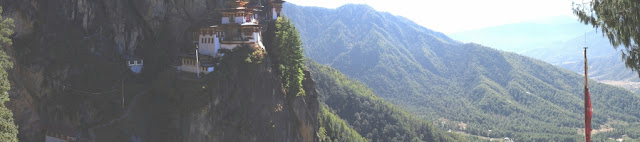
Our day started with a long, but incredible, drive from Punakha to Gasa. We stopped for lunch at an overlook that gave us the above view. Later, entering our first national park, the scenery changed. We were in the world of the temperate Himalayan forest, thick with heavy trees covered in droopy lichens. Streams and springs spouted water, creating waterfalls at nearly every turn.

Jigme Dorji National Park entrance with faux takins...they're the only ones we saw in this area
(Act I has a description of takins, the national animal of Bhutan,
and capital city Thimphu has a sanctuary we visited)


Our excitement mounted. Our mission today was to get to Gasa, set up camp, and prepare to start our trek the following morning. Our belongings were separated into three bags: each of us had our trek bag, which held our own gear but would be carried by ponies; our daypack, which we carried ourselves and had whatever we'd want to access during the day; and our leave-behind bag--the rest of our luggage--which stayed in the van while we were trekking. Tandin, our van driver and my birdwatching partner we affectionately called Tin-Tin, would stay with the van to keep things secure; we'd miss him!

Gasa's monastery, overlooking the community
We met one of our trek guides, Karma, this morning (a close friend of Norris's as well as an integral part of Ugyen's team of guides), and met our cook ("Cookie") in the afternoon at camp. Cookie and his helpers brought the rest of the supplies--food, tents, bags, sleeping pads, and 16 ponies to carry everything. We had started our Diamox (altitude sickness pills), our trekking poles were clean and shiny, and our water bottles were full of the last bottled water we'd see (from now on, it's boiled and we'd get it hot right out of the kettle). We were about as ready as could be, so all we could do was enjoy the ride.

Typical countryside; steep mountains and terraced agricultural fields.
How in the world were these made? 
While we were a cohesive team--new and old friendships had bonded over the past several days--we knew that each of us had the responsibility to be as smart and ready as possible. One major goof could affect the entire trek for everyone.

Our campsite for this pre-trek night was adjacent to the community's soccer field. A game was being played by local kids and monks. Walking from the van across the soccer field to our camp, we saw that Cookie and his helpers had set up camp in advance. Tents, a bathroom tent (open it up to see a hole in the ground, but there was toilet paper available; what more do you need, really), a cook tent, and a set of tables and chairs for dining greeted us after our drive.

A pick-up soccer game between monks and kids

We selected our sleeping bags and pads, and began setting up for the evening. In a couple hours, come dark, we were going to walk back to the van and drive to the far end of Gasa to their famed and revered hot springs. We'd get in a good soak, wash up, head back to camp for dinner, and then hit the hay.

Shivering in the tent, I quickly changed into my swimsuit for the hot springs visit, adding more layers to warm up. It was already starting to cool down quickly. At around 9,000 feet with mountains all around you, the sun disappears early and the cold starts to set in immediately after. Recognizing that I'd have wet hair and be even colder after the visit to the hot springs, I placed my new warm gloves and hat on top of my pile of toiletries and towel. I crawled out of the tent, ready to have my happy hour glass of wine with the group, leaving my hot springs pile outside the tent along with my perpetual companions--binoculars and camera.

I stood up and looked around. My gosh. I took a deep breath of clean, brisk air. Ponies were tied up a short distance away (on one side of the soccer field), silhouetted by the darkening sky. Mountains surrounded us; the only flat land I could see was the soccer field and our little bench of tents. An energetic soccer game between monks and students and heavy bells on the ponies provided the only sounds--it was peaceful and serene.


I had to pinch myself to believe I was really seeing this
Walking down to get my wine, I met up with Ugyen. "Suzanne!" he said, "Tin-Tin wants you to go to the van. He has a bird for you." "Ugyen, are you sure?" I asked, surprised. What bird wouldn't have flown away at this point? Plus, wine was waiting!!!

"Oh yes, it's just sitting in a tree. He wants you to see it." I went back to my pile, grabbed my binoculars and field guide, contemplating bringing my camera but figured it's too dark already, and trotted across the field. Sure enough, a pair of Hoary-throated Barwings were sitting in a tree, with the front seat of the van being the perfect vantage spot. I climbed into the front seat, Tin-tin in the driver's seat, and we enjoyed watching the birds as they bopped around the tree, perching together at times. Geez, I thought. I really should get my camera...

Decision made; go get the camera. I raced back to our tents to my pile. The camera was there. I grabbed it and turned to race back. My brain flashed words like a neon sign: "gloves and hat missing, gloves and hat missing." As I ran back to the van, I wondered if I had grabbed those gloves and hat the first time? Would they be in the van already?

The Hoary-throated Barwings had flown. Shoot. I looked for my gloves and hat in the van. No luck. Now I was really confused, they must be back at camp, right? I went back to the tents to check. Happy hour over, everyone was getting their supplies ready for the hot springs. I stood over my pile of stuff. No hat, no gloves. Both gloves and my hat were missing.

That's when full-fledged panic set in. I ran around the tents, growing ever more frantic. I even checked the bathroom tent, hole and all (ewwww!). Nothing. It was then that I asked the rest of the group, in a trembling voice, if they had seen a hat and gloves, and described them. No; no one had.

I ran back into my tent. I pulled everything out of my duffel. I examined every nook, cranny, and pocket of my daypack, fanny pack, and anything else that held other things. Nothing.

Did I carry them that first run to the van to see the birds, and drop them next to the soccer field when I ran? Are they near the ponies? I scanned the field--nothing. The realization that I may have lost two critical items was sinking in. Think about it. Picture being cold, camping at 13,000 feet elevation in the Himalayas dammit, and not having gloves or a hat. This was serious.

Nearly in tears, I had to admit to everyone I lost my hat and gloves. People rallied to help look, to no avail. It's like they were spirited away, beamed up to a different planet like Captain Kirk on Star Trek. Was I going to be the one who goofed and caused our trek to suffer?

As much as I wanted to know what the heck happened, it was time to figure out what to do. On our drive to the hot springs, I confided my fears to Tin-Tin and voiced my alternatives. I did have a thin pair of those inexpensive knit gloves that run about two bucks at Wal-Mart; they were supposed to be a little extra help under thicker gloves. Now they would have to do. My lavender puffy coat had a snap-on hood that looked like an astronaut's helmet, especially when not joined with the coat. That would have to be my hat, on the coat or off.


The biggest physical feat of my life started tomorrow, and I was suddenly unprepared. Now my confidence was shot, and it was obvious to Tin-Tin that I was still apoplectic with fear.

Tin-Tin. Birdwatcher, van driver,
most importantly, friend
--Emily's picture--
Buddha, in the name of all that is holy, please remember to bless that man Tin-Tin. He had a new pair of gloves he had bought right before this trip to keep him warm while he was waiting for us in the van for the duration of the trek. He pushed them to me, insisting I take them. I was overwhelmed. Tears of gratitude pricked my eyes. Certainly, this was one of those events that decades from now, I will remember how I turned from panic-stricken to calm the moment I realized that with those gloves and my puffy purple helmet, I would be OK. Not perfect, but OK. Breathe deep. A hot tub awaits.

Not my photo: slurped from Google
Ramadas cover various hot tubs at Gasa hot springs

Regarded as a holy site with healing powers, the Gasa hot springs attract people with physical ailments and injuries. Whole families trek to Gasa to bathe in its healing waters. Each large, wooden tub could hold about a dozen people, and there were probably eight tubs, plus a wall of pipes pumping out water for post-soak cleansing. Each tub was attached to a separate hot spring, so each tub had a different temperature. A poster would list which tub would be best for which ailment. Tubs are almost always crowded. Guest houses up the road (essentially buildings with rooms--no furniture, just walls and floors) were available for overnight stays. We soaked for a bit, chatting away, cleaned up, and rode the van back to the soccer field.


Scene II: Time uncertain, it was extremely dark
Inside a freezing tent

I dressed warm, thanking the powers above that I had selected Julie's sleeping bag liner over my pricey-but-cheap fleece sheet. Hah, like that fleece sheet had a CHANCE against this. Body-searing cold got into my core and would throb outwards as the external cold continued to pound inwards. I could feel it, but pushed aside my thoughts about how much colder it might be 4,000 feet higher up.


Contorting myself into my sleeping-bag-within-a-sleeping bag (zippers aligned), I was wearing what I rationally thought would be enough, given that body heat does help warm things up. Light socks and warm woolly socks; leggings; undershirt, long-sleeved shirt, fleece top; my thin gloves. I made sure I went to the bathroom at the last minute, as one generally does while camping. I lay in my bag(s), Purple Puffcoat as a pillow, and waited for sleep to take over.


Instead, I was visited by the Demon of Irrational Nighttime Thoughts. Don't we all have those nights? When, the next day, you wonder why you wasted so much precious sleeping time imagining things that, in daylight, are patently ridiculous? I was mentally exhausted from the freak out over the missing gloves and hat. That problem had been resolved, though, and I really needed some sleep for the trek tomorrow. Yet the Demon took over. Could I really do this? What if I have a heart attack? Did I forget anything? And on it went.


As I fretted in silence, I noticed that if I moved even one toe, I'd hit a cold spot in the sleeping bag, and that little piece of cold would vibrate up my body. I had to admit to myself I was still cold. So much for body heat. To make matters worse, now I had to go to the bathroom. Argh. I thought I could change positions to relieve pressure on my bladder, but that would mean a jolt of cold that might require hours of recovery. Moving a toe was bad enough! A resolution to both issues, of course, would be to just get the hell up, go, and add more layers before crawling back into the double-mummy bag.


Muttering foul language, I unzipped the outer bag, found the zipper to the inner bag (no longer nicely aligned with the outer bag; yeah, that's fun), grabbed the flashlight, got out, put on shoes, and stumbled to the toilet tent. Business done, I stumbled back, took off shoes and put on Julie's borrowed down booties (holy smokes, thank you for these!!), another layer of pants, and Purple Puffcoat, helmet-hood secured. Burrowing back into my bag(s), the added layers helped a bit. Wide awake, though, my mind fretted on about all sorts of irrational things. I think I dozed off and on until the morning light of Trek Day 1.

Purple Helmet!


Read about the Trek, in Act IV, here.

For more information on our tour company, please visit Druk Leisure Tours.


Saturday, December 10, 2016

From Laya to Leech Socks: The Highs and Lows of an Asia Adventure, Act II

Act II: Three Days to Two Days, P.T. ("Pre-Trek")

Scene 1: Three Days P.T.
Steep trail to Taktsang (Tiger's Nest) Monastery

Trekking poles attached to my wrist, Camelbak water bladder full, and fanny pack loaded with camera, batteries, and lip balm (never go anywhere without it!), I joined the rest of my group on the trail to Taktsang (literally, "Tiger's Nest") Monastery, one of the highlights of any trip to Bhutan and probably the most sacred of all temples and other holy sites in the Kingdom.


But first, we had to learn: what tiger, what nest, and why on the side of a near-vertical cliff?

It's a bit complicated for this American non-Buddhist to explain, but here goes. It is believed that, in the 8th century, the now-revered man who brought Buddhism to this area, Guru Rinpoche, flew to this location from Tibet on the back of a tiger. A cave behind this temple (the temple was built centuries later) served as the "lair" holding the tiger and acting as a sanctuary for the meditative Guru. An alternative tale is the former wife of an emperor in Tibet willingly became a disciple of Guru Rinpoche, and transformed herself into a tigress to carry the Guru on her back to this site. Regardless, in one of the caves here, the Guru meditated for 3 years, 3 months, 3 weeks, 3 days, and 3 hours, emerging to bring Buddhism to the people of Bhutan, keeping the tiger (or tigress) bound in his (or her) lair, or nest.
Nine centuries later, in 1692, Tenzin Rabgye built the temple on this consecrated spot. Some believe that Tenzin was the reincarnated form of Guru Rinpoche. In any case, the temple has undergone some restoration, but largely is, and feels, ancient, holy, and sublime.


To get there, both the Guru and Tenzin didn't want to make it easy. The trail to Taktsang goes up. Uppity up up 3,000 feet above the Paro valley from whence we came.


Starting out. Seems flat, but not for long.
Our hike took us by a few religious structures and prayer wheels that have been built along the way; some have commemorative "tsa-tsas" containing ashes of the dead left by loved ones.


Prayer wheel in constant motion from
a stream flowing through it.

Tsa-tsas left by loved ones.
It was also our introduction to prayer flags. Prayer flags are placed where sky, water, and trees intersect by anyone who wants to send wishes, prayers, or requests to the Buddhist gods. Sky, water, and trees--by coming together, the wind from the sky blows these prayers down from the forest through the water, downstream and out to reach the gods. Norris and Ugyen purchased a line of prayer flags for each of us, and everyone but Sherrie and I placed prayer flags along this trail. I admit, we missed out. However, we were promised that we could put our flags up at a place that would have meaning for each of us, so we held onto our flags for a future unknown, but no doubt perfect, time and place.


The trail has a couple primary resting viewpoints; one has a large prayer wheel and a series of smaller ones (and modified water bottles forming others); another spot overlooks a trail to a small restaurant.

Taktsang hugging the cliff to the right of this large prayer wheel.
Hmmm...what is that little structure on the top of that ridge above the prayer wheel?

What to do with all those water bottles? Make prayer wheels!
To reach the Tiger's Nest, after going about as far up as we thought we could handle, we had to descend what feels like a thousand steps, and then ascend a similar height back up to, finally, the monastery. Well done! We passed the first hiking test, or so we thought.

A bunch of up, then this trail down...
And then back up!
As with all temples in Bhutan, no shoes or cameras are allowed in, so bags are checked, shoes are removed, and we enter inside to see multiple sacred alters and smaller prayer areas or temples, connected by a crazy labyrinth of staircases. One small alcove leads you down a dark hole in the rock (a long wooden pole with knobs for your tentative feet to balance upon is the only support) to a candlelit nook that is the true Tiger's Nest cave.


It was an incredible first step into understanding Buddhism, and we were only beginning to see the complexities associated with this faith. Returning to our shoes and bags, Norris and Ugyen pointed out that smaller temple built waaaayyy up above us on a nearby ridge. That was our next stop. What?

Yeah, that small structure we saw before? Forge onwards and upwards.
Here we are.
It was a serene change from the popular and peopled Tiger's Nest trail. Lunch was waiting for us, graciously prepared and served by the monks living there--the Zandropelay temple and monastery. We were brought into a comfortable room filled with benches, blankets, and tables, and served rice, butter tea, rice noodles with cheese and chiles, and more. It was a feast--and thinking that these humble, devout men probably never ate that much food in a day gave us pause to reflect how generous and kind they were towards these strangers from a different world. And we also realized how special this trip would be, thanks to Ugyen and Norris, knowing there were more unique opportunities awaiting us.

We learned that this monastery is home to a number of orphaned boys--boys in training to become Buddhist monks. Studying and learning scripture and the Buddhist faith, these boys are also educated in general studies that most of us had--math, writing, reading, and so on. Chores and playtime are included in their daily routine. However, memorizing a new scripture every day is of utmost importance. These boys congregate at least twice a day for an hour or two at a time, each memorizing their individual scripts. At the end of each studying day, they must recite their script word for word to their senior monks. A mistake means they're back on the same script until no mistake is made.


Witnessing these boys intent on learning their scripts was one of the most memorable scenes of this trip in my mind. The sight is more powerful with the sound:

Stomachs full, we were in no mood to hike back to the van; alas, it had to be done. Down, down, down, and down some more (wait, don't forget going back UP the one steep descent we had on our way to Taktsang!), we finally arrived at our van. We barely had enough time to get back to our hotel and have dinner before our heads crashed on our pillows. The dogs and their nighttime barking, which kept many of us awake the night before, seemed to be much less disturbing to us tonight!


Scene II: Two Days P.T.
Somewhere Seemingly on Top of the World

Flying above and through the Himalayan mountains: check. Tiger's Nest: check. Butter tea: check. It wasn't really real, though, until Dachu La.


Dachu La Pass is where the Himalaya in your mind meets the Himalaya that you see. A line of snow-capped peaks, only visible on a cloudless day, takes your breath away. The pass, at 10,300 feet elevation, is a popular spot, especially on days without clouds. Which happens quite a bit in November, since the rainy season has ended, and winter hasn't set in quite yet.


It was glorious. A perfect day to see a simply stunning view. Norris claimed this was the best view of the mountains he'd seen in his visits here. Word must've gotten out to every tourist in Bhutan, because I think they were all here to enjoy it.


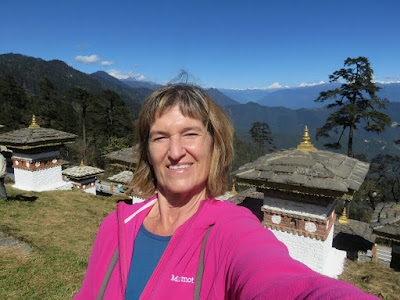
Geez, here I am, one of the dozens of tourists taking selfies...

Sent to my mom: See, I'm in the Himalayas!!!

Even dogs hang out at Dachu La
Dachu La Pass was historically a primary route between Thimphu (the current capital of Bhutan) and Punakha (a previous capital). Ancient trails can still be seen; a temple is located here, as well as 108 (a significant number in the Buddhist religion) stupas, small religious memorials also known as chortens. At Dachu La, these are known as "Druk Wangyal Chortens," built by the eldest Queen Mother. Also on site is a monastery built in honor of the 4th head of the state of Bhutan, Druk Gyalpo. These structures are adjacent to Bhutan's first Royal Botanical Park, which we later drove through on our way to Punakha.

A few of the 108 stupas, or chortens, adorning Dachu La Pass
Pictures (one of our best group shots, thanks to Eric) were taken, and off we continued on our way.


We stopped in the city of Punakha, which has a Dzong (temple, monastery, and fortress) that was far and above one of the most breathtaking feats of human construction I have ever seen. This Dzong, befitting a former capital, impressed us from across the river, before we even reached it:


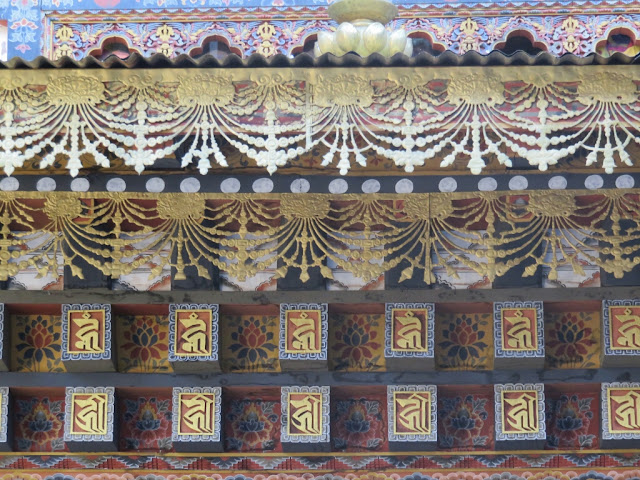
After crossing the river and entering through the gates, our mouths were agape at the courtyards (more than one) and intricate details of the hand-painted pillars, walls, and eaves.


The temple was beyond belief. I think of Al Pacino's line in Scent of a Woman: "I been around, y'know?" For the small amount of traveling I've done, I've seen the Hermitage, the Louvre, and the Manaus Opera House...and this temple was up there. Due to the no-camera rules, I have no photos of the temple's interior. Inside, among 36 gold pillars, three large Buddhas, and ornate alters, statues, holy water vessels, and more, the walls had hand-painted, detailed murals depicting the life of Buddha. Ugyen walked us through all the scenes, giving us a brief history of Buddha and his stages of life, his understanding of life, and his philosophy that seems to simple (love is eternal).


We walked out of the temple to see some of the outer murals (photo-friendly), and meandered down the temple's many entrance steps, only to look back in awe.

The signs of the zodiac

The "Four Friends," a core Buddhist story of
the elephant, monkey, rabbit, and pheasant working together
so they all benefit from the fruits of a tree

Black-necked cranes, birds of beauty and meaning to the Bhutanese


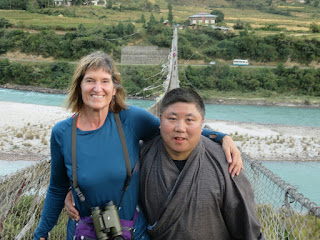
The day was not done yet! A short side trip to the country's largest suspension bridge was a kick:

Note the dog...

and monks...it's a busy place!


Sue and Ugyen!
Staying in Punakha that night, we re-packed everything to prepare us for what was next (cue the dun-dun-DUN music)...The Trek. Everything we think we needed for the next five days went into one bag (five nights camping; four days trekking). The rest, which we wouldn't see for possibly eternity, went into another. With a bit of trepidation, we slept, thinking "this is the last bed/shower/pillow we're going to see for a looonnngggg time!"

Next up, Act III

For more information on our tour company, please visit Druk Leisure Tours