Act 1: Eight to Four Days P.T. ("Pre-Trek")
Scene 1: Eight days P.T.
My house, guest bedroom: filled with piles of clothes, camping gear,
gimmicky travel things, and tiny bottles of shampoo
I held both sleeping bag liners in my hands, needing to make a decision on which one to pack for my upcoming trip to Bhutan as an aid to the provided sleeping bags--bags I was told would need supplemental warmth. One was my brandy-new lotsa-money just-received ultra-compact liner, made of what looked like, now studying it in real life, thin, cheap fleece. But, packed in a small drawstring bag about the size of my fist, it certainly appeared perfect for travel! The bag's label promised it would add 25 degrees of warmth to a sleeping bag, although it didn't quite explain how (magic?). The other, borrowed from my friend and neighbor Julie, was basically a lightweight sleeping bag, three times the size of my tiny one. Looking at both, I was hoping that I could finally be one of those people who could claim they "travel light," pirouetting through the airport with no checked bag to mess with, gleefully living off two pairs of underwear, a pair of pants, a top, and a jacket, and some small travel gadget that can do 50 different things including trim hangnails, charge tablets, and fix a stalled bus. To do that, every little bit of minimizing helps, so I was leaning towards my new, compact, magical liner.
Really, though, the thin fleece looked like it was probably made from discarded airplane blankets. I opened it up and could see through it to the bedroom doorway, where my dog was studying me. Through the film of fleece, I watched my dog's face change from a sort of everyday, entitled expectation of perpetual happiness and treats to a blank, ever-more-despondent stare as she realized I was packing something to go somewhere, and she wasn't part of the adventure. She sulked off, tail and head hanging down, plotting revenge. Well, that would be Bruce's problem, not mine.
Probably making one of the best decisions I've ever made in my life, I looked at my new ultra-thin liner, grimaced at my foolishness in believing its advertising claim, and set it aside, shutting the door on it and the whole "I'm a light traveler" fantasy. I stuffed Julie's liner into my duffel bag and left my pricey, flimsy fleece sheet in the closet.
I needed all the help I could get, so the thicker liner was one of many items that got transported in my huge duffel bag (light travelers, seriously, rot in hell) to the Himalayan mountains. Also included were down booties, insulated pants, a down vest, many warm socks, a fleece jacket (heck, the jacket was thicker than that silly liner), and a lavender puffy hooded coat that made me look like a purple Michelin Man. Most were either given to me by friends who didn't need them back, or, like that coat, bought in a thrift store. Their final mission: get me through this trip. I did smile when I packed the brand-new gloves and double-layered hat I bought. No chances taken there, they were perfect. Despite my apprehension about the upcoming trek, I was looking forward to the warmth that would envelop me when I put those babies on my head and hands.
As I was preparing my miniature toiletries and pills for every problem that a traveler could possibly experience, I couldn't believe that after six months of preparation, it was finally time! Time to board a plane in Phoenix; fly to Los Angeles; then to Singapore via Seoul; then to Bangkok; and then, finally, to Paro, Bhutan. Six months of planning flights, getting shots, finding passports, charging batteries, buying stuff you did (and, I guess, didn't) need, and dreaming of the exotic places we'd be seeing. I was about as ready as I was ever going to get.
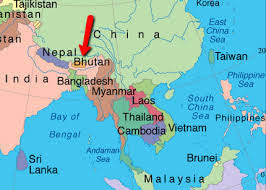
Bhutan--how, why, and where the heck is Bhutan anyway? I was often asked those questions by friends and family or passers-by; in truth, most even mispronounced Bhutan (it has nothing to do with the Bataan Death March, people). Why not, answered I. Actually, our group of 12 jumped on an opportunity coordinated by Norris, a long-time friend and colleague who conducted some wildlife research in Bhutan, a small country one-tenth the size of Arizona nestled in between India and Tibet. Two years prior, Bhutan selected Norris, a wildlife biologist, to help them research the best alignment for a new cross-country road that would help connect remote, roadless communities but not overly impact wildlife. Having traveled there for his research more than once, he presented his story to our community a year ago. His photos and description of the country and people of Bhutan were so enticing, many of us asked him to coordinate a trip just for fun.
Which he did, and several of us signed up. Friend Sherrie, who has known Norris for over 30 years, and I were to be rooming buddies. Others included Lynn, a veteran hiker and traveler; Eric, Norris's brother; neighbors Cathy and Jim who signed up less than three minutes after reading the trip description I sent them; and Emily, another work colleague of Norris, and her husband Russ. Norris's family--wife Becky and daughters Liz and Rose--rounded out the group. Ages ranged from 23 to 75. Had any of us ever thought we'd go to Bhutan? Probably not, at least up until a couple years ago.

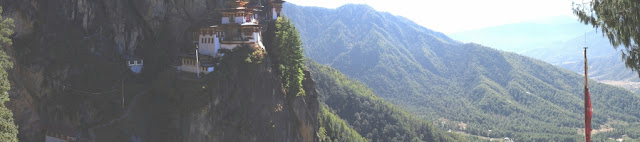
What an intrepid group we were. Norris and his Bhutanese guide, Ugyen (Druk Leisure Tours) put together a 12-day itinerary that promised a broad swath of experiences, such as visiting the country's famous Tiger's Nest monastery; other temples or fortresses ("dzongs"); and popular attractions such as the country's longest pedestrian suspension bridge, famous and revered hot springs, their natural history museum, and craft shops that showcase weavings, wood carvings, and more. What set this trip apart, in my mind, were three other opportunities that are not generally available to most tourists.
First, we would be able to visit at least two schools that are a focus of Becky's separate work project on early childhood development, meeting schoolchildren and teachers and providing them with school supplies we will have brought over to donate.
Second, we were visiting over one of their national holidays, an Annual festival celebrating the return of the black-necked crane to winter in the Phobjikha valley. This rare and declining species has been recognized as an integral part of the Bhutanese culture, and this community's festival includes dances that celebrate these unique birds. One of the most well-known and beloved was the annual "crane dance" put on by the valley's schoolchildren, dressed as cranes and mimicking the bird's feeding and flying behavior.

Third, and probably the one thing that made me more nervous than I had been in a very long time, we would embark upon a 4-day trek from Gasa (small community at the end of a road) up to Laya. Laya is an even smaller community with no road access, somewhat close to the Tibetan border. "Close" being relative since there was still a part of the Himalayas separating them. While Gasa and Laya are only about 20 miles apart, connected by a winding, and largely uphill, trail, Laya is much more representative of the indigenous Layap people. Layaps are mostly yak herders, with a unique culture all their own, moving south to Gasa with their herds in the absolute dead of winter, but returning for about nine or ten months of the year to their homes 13,000 feet high, tucked in the Himalaya. Our trek would consist of two days and about 18 miles up to Laya, then two days back, returning to Gasa and our van.

This trek had me both excited and apprehensive. I sort of pride myself on my general tendency to travel to crazy places to follow one of my main passions, that of thrashing about wherever I go to find new bird species to add to my "life list." I can camp, I can hike...I can TAKE IT (
see me beat my chest). But the nerve-wracking part was the knowledge that I really didn't like to be cold. Especially for an extended amount of time where getting warm would be a fantasy. This trek...well, it was going to be cold. Very cold. I'm not a happy person when I'm cold, especially when there are no immediate means to become warm. Campfires don't help much since freezing sets in the moment you step away. My hardy Minnesota genes abandoned me the minute I moved to Tucson, Arizona over 30 years ago, and I really needed those genes back to kick in when needed. Hint: they didn't:
 |
| Look for the lump in the lavender puffy coat... |
We were going to pack in a lot of interesting stuff in those 12 days. In looking at the globe, I realized I was flying about as far away from home on this planet as one could get. Never having visited Asia, I figured I might as well take advantage of being there, and do some fairly intense, but none-too-obsessive birdwatching for an additional week in Thailand, a country with 10% of the world's known bird species. I searched online for a bird guide, and found
Nick Upton, a Brit ex-pat who has lived in, and birded, Thailand for over 20 years. Speaks English (yay, communication!) and knows what he's doing, expertly so. He and his guides Ralph and Nit were willing to take me on a birding journey across central Thailand. I was set!
 |
| Thailand: A change of pace from Bhutan |
All in all, I would be gone from my nice warm home, husband, and dog for almost 4 weeks. That was a long time. But an opportunity to visit Bhutan, let alone Thailand, does not knock on my door very often. Bhutan is a fairly secluded country virtually untouched by western civilization for hundreds, if not thousands, of years. Bhutan was ruled by a series of Buddhist kings under an absolute monarchy until 1953, when the king at the time created a national assembly to promote democracy. Slowly over a few decades, but finally in 2008, Bhutan became a constitutional democracy, handing most administrative powers to a council of ministers--including the power to impeach the king. To date, that has not happened, and it seemed to me that most Bhutanese revere their current King Jigme Khesar Namgyel Wangchuck and his wife, Queen Jetsun Pema.
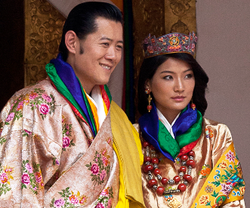 |
Apparently, this royal couple trekked the same trail we took (and more)
in a multi-month venture to bring medical supplies to remote villages.
This is not your ordinary royal couple. |
Borders were opened up to the world in 1974 (but TV and internet not welcomed until 1999), albeit with a carefully orchestrated set of rules. Visitors must be accompanied by certified Bhutanese guides. Every visitor pays a daily fee, which covers this guiding service, lodging, meals, and transportation by said guide, and also gives a boost to the general treasury.
Bhutanese for the most part live their lives closely entwined with Buddhism. You simply can not visit Bhutan without seeing the influence of the Buddhist faith in Bhutanese daily lives, interactions, and culture. This peaceful and serene approach to our earthly life, and life beyond, has resulted in their moniker "happiest place on Earth." Which could very well be. The Bhutan government measures this happiness (truly, they have a Gross Happiness National index) and in visiting Bhutan, you can't help leaving without realizing that yes, material "things" we seem to covet are simply not all that important in the grand scheme of living a happy life.
 |
| Two very happy Bhutanese: Guide Phuntsho, left, and fearless leader Ugyen |
Act I, Scene II: Five days P.T.
On a Singapore Airlines plane, where class and elegance reign,
with the exception of 12 overly-excited American travelers
heading to Bhutan
Bags packed, Sherrie and I made our way to Phoenix the night before departure, and stayed with Cathy and Jim. We met most of the group at the Phoenix airport, and a few others in L.A., bound for Seoul, Singapore, Bangkok, and then finally Paro. We were excited! Scrubbed clean! Snacks packed! Survival kit (books--real or virtual, compression socks, slippers, puzzles, neck pillow, Ambien, toothbrush, comb, etc. etc.) ready!
 |
Jim, Cathy, Sherrie, and I. What's that saying, something about
ignorance and bliss??? |
Our Singapore Airlines plane left L.A. for its 12-hour flight north/northwest across the western Alaska/Aleutian Islands and down the eastern Asia border to Seoul (which made no sense until I saw it on the flight monitor). A brief stop and plane-change in Seoul allowed us to enjoy the 3 hours that we got of October 31; due to the time changes, we lost nearly a day in traveling westwards to Asia. It was enough time, though, for Becky to hand out Halloween candy she had squirreled away for just this moment.
 |
| See? Logical! |
 |
| Getting comfy |
 |
One of about 4 meals served; wine; and watching
the Jungle Book on my personal monitor |
 |
| Wine AND ice cream, Sherrie? Sure!!! OK, me too! |
A haul still remained. Singapore to Bangkok is a six-hour flight. I couldn't believe how big southeast Asia is. Heck, I thought Seoul was a stone's throw away from Thailand. Wrong. I am as bad as those "you're going to Bataan?" people. At least Singapore Air made it enjoyable--the service was impeccable. Attendants still wear the long, flowered skirts and blouses designed in the 1960s; their coiffed hair stays perfect during the flight's duration, as we travelers grow ever more scraggly as the hours tick by.
 |
| (not my pic; slurped from Google Images...) These ladies are pure class |
We spent the night in Bangkok prior to our last flight to Bhutan. Our hotel was charming, clean, and air-conditioned,and welcomed us with a stuffed elephant on each bed. Perfect.
 |
Approaching Bangkok. Little did I know I would be
birdwatching along these rice paddies and shrimp farms in two weeks |
 |
| Suvarnabhumi Airport in Bangkok. I can type it, but can't pronounce it. |
 |
| The Mariya Boutique Residence welcomed us |
Act I, Scene III: 4 days P.T.
12 excited Americans fly into, land, and
begin their journey in Bhutan
We left the following morning for Paro, Bhutan with one stop in Calcutta (or Kolkata), India. One more hour to go! We left Kolkata, and soon, the steamy tropical landscape turned into the foothills of the Himalaya. Then boom! The line of snow-capped mountains appeared. The Himalaya!!! The background murmur of fellow passengers became noticeably louder and more excited. Some peaks popped out higher than the others. Norris and the pilot pointed out a few of the more prominent peaks. Closer and closer we approached. How are we going to get from up here to down there, in a jet airliner, safely?
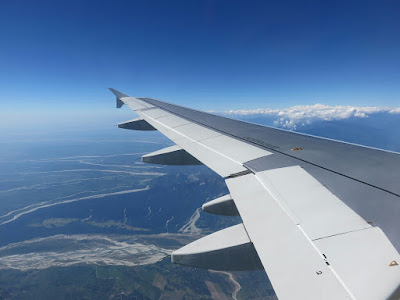 |
| Leaving the foothills behind |
The Paro airport is on almost every list of "
Scariest Airport Landings." There are only eight pilots that are certified to land a plane in Paro. Landing requires first that the captain have visual sight of the landing strip. If it's cloudy, well, it sucks to be you, because you're either turning back, or flying around in circles waiting for clouds to break. The plane must descend into a valley ("valley" implying there are mountains on either side of you, right?
Himalayan mountains...), then make two near-90-degree turns as it continues to descend. While the plane is still righting itself from its last turn (and you can look out your plane window and see what TV program is on in the closest house that you're zooming by), it lands. Applause breaks out upon touchdown.
 |
| Howdy, folks! |
 |
Turn into the distant valley; then
turn into the foreground valley, then
turn to face the runway. Fun! |
 |
| Image from weblink "Scariest Airport Landings" |
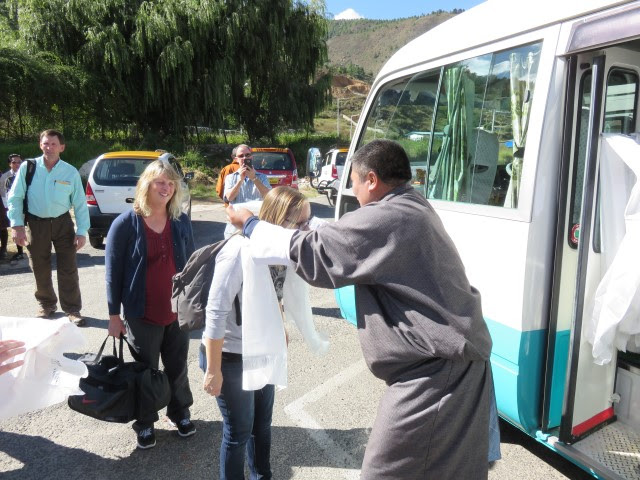
Norris guided us through the entry process and into sunny Paro. Finding Ugyen, the two friends reunited with gleeful hugs. Ugyen and two other Druk Leisure Tour guides, Tandin and Phuntsho, presented us with white welcome scarves. We were on our way! We arrived at our first hotel, got settled, met for tea, and then visited the country's natural history museum.
A fascinating place, the natural history museum was a good introduction to the world that is Bhutan. Like finding out what is a takin ("tah"-kin, not like "what's takin' you so long?") and why it's Bhutan's National Animal.
"The Divine Madman, a wise yet crazy saint otherwise known as Lam Drukpa Kunley, was asked to perform a miracle by local villagers. He said he would if they would bring him a cow and goat to eat. Confused, the villagers prepared a roasted cow and goat, presented it to the Divine Madman, and watched him devour both, leaving just the bones. The Divine Madman then took the head of the goat, attached it to the skeleton of the cow, clapped his hands, and the skeleton grew a full body. The takin was born."
 |
Head of a goat, body of a cow, or possibly an antelope. May I present:
The Takin. |
We were off and running. The next day would be our hike to the Tiger's Nest Monastery, and then we'd make our way to Gasa in preparation for The Trek.
Next up? Act 11!
For more information on our tour company, please look up Druk Leisure Tours