As a young, fairly penniless graduate student at Tucson's University of Arizona, I had a job that helped make ends meet. I worked for Pima County Parks & Recreation transplanting cactus (huh?) from the impending blading of the desert for construction of the Central Arizona Project water canal to revegetate trampled areas adjacent to roads in Tucson Mountain Park. My co-worker and now good friend Dianna and I worked fairly solo, with park staff Billy and Manuel checking up on us on occasion.
The labor was pretty intense for two gals in their 20s: use pickaxe and shovel to dig out cactus from the canal location, truck them to the park, and re-vegetate designated areas by using above tools to break through caliche and hard crusty rock to put these things back in the ground. Spines, and worse, glochids (masses of fine but strong hairs), would embed themselves into our backs and arms and break off, requiring constant daily tweezing or endless festering.
But we couldn't complain, really. We weren't sitting at a desk filing papers or answering telephones, we were physically active at one of the most beautiful places on Earth: Tucson Mountain Park. It was fantastic; I had a full year to observe daily changes in light and rainfall, flushes of wildflower and cactus blooms, the survival of same plants through the hot and dry months...it was breathtaking and well worth the cactus wounds and tired muscles.
Not a bad "office"
Since then (we're talking 35 years ago, egads!), I have made several moves and landed four hours away at my current residence, far enough away from Tucson Mountain Park that it's not a regular place I visit any more. Until now, I felt that my year there gave me what I wanted to learn about that special place, that I "knew" the park, its feel, its landscape, what it wanted to teach me; that any subsequent visit would be like visiting an old friend. I'd say hello and then settle in, comfortable in familiarity.
Until now...
As luck would have it, fellow camping friends Bob and Moira (see my And Carly Too page for our Inaugural Journey and our summer Greer trip) invited us to join them at Tucson Mountain Park for several days of general enjoyment of the Sonoran desert in winter. Bruce and I couldn't say no to that, and after making reservations months in advance (it is the Year of Covid Campers after all), we met up for five days of life in Tucson Mountain Park.
Nice view from Campsite A-18
WOW. Tucson Mountain Park, I hardly knew ye. I remembered the beauty but realized quickly that I didn't know much else, including the history and naming of features. How the park came to be is a combination of vision, leadership, entrepreneurism, hard work, and a little luck. C.B. Brown, Pima County's first agricultural agent in 1920, proposed removing the mining claims from at-the-time federal land to preserve this area he had come to appreciate for its natural beauty. Brown Mountain and the trail around it is named in his honor. Jack Kinney (of Kinney Road traversing the Park), a Pima County Supervisor at the time, helped Brown set aside and acquire both the current Park and what is now the Tucson Mountain District of Saguaro National Park. J.C. McCain (of McCain Loop Road) was Tucson Mountain Park's first park ranger. Here's a good summary of how one of the largest parks managed by a local government came to be.
Sun rising through Gates Pass
Morning walks with Carly involved PAVEMENT ONLY after curiosity and sniffing led to a mouthful of cholla cactus
One of our days was spent at the Desert Museum, always a fantastic place to visit. Thank you, Kerry, for your hosting and added insights as a Trustee into the history and context of this magical place!
Mexican Gray Wolf, endangered and reintroduced in my neck of the woods
Crested Caracara, a bird of the desert growing more populous in this area
Desert bighorn sheep ewe, one of three sheep at the Museum
A Spiny-tailed Iguana perching in the sun overlooking the sheep
Black Rattlesnake
Thank you for the separate enclosure from Mr. Black Rattler. Sincerely, Mr. Gopher Snake
Mexican Leaf Frog
Masked Bobwhite, a rare subspecies of bobwhite, in the Museum aviary. Attempts at re-populating the species at the nearby Buenos Aires National Wildlife Refuge continue today.
Besides the array of Sonoran desert critters at the Desert Museum, the park's natural display did not disappoint either:
Black-throated Sparrow
Curve-billed Thrasher
The sweet Phainopepla
A Red-tailed Hawk surveying its domain
And the hiking trails! More trails than I remember. In the years of living in Tucson, I hiked a few, but there are miles more I want to explore. Thanks to our friend Walt, who lives adjacent to the park and has threaded his way up and down and across and back on all of them, I got a taste of the joy of hiking in this phenomenal place.
Bruce and I explored a bit of the Brown Mountain trail
Awed by these desert sentinels
Stands of Chain-fruit Cholla edged the trail, we were stunned that mountain bikers raced through with little protective gear!
Walt pointing something out to us (Bob, Chester, Jane, and Moira)
Hiking towards the ridges in the distance
And here we are. Oh, the views!!!
Walt's love of this park is contagious, thank you, dear friend!
We weren't at Tucson Mountain Park long enough to satiate my thirst, and I need more. More of its tranquility, beauty, and peace; more walks along its trails and watching the light change from sunset to moonlight on centuries-old cacti. I am now driven to come back, again and again, because its obvious there's so much more to bring into my soul from this special place.
Thank you Bob and Moira, for including us in your camping plans and introducing us to your friends Jane and Chester.
Thank you Walt, for your boundless love of the Park and enthusiasm for exploring every inch of it.
Thank you Kerry, for your visits and as always your informative updates on the fascinating wildlife studies occurring in the Park, especially bobcats.
Thank you Brooke, Fran, Nancy, and Gita for taking the time to swing out to see us and visit! So great to see you all!!!
Centuries ago, the country's founder saw the red light from the setting sun light up the wings of a white eagle. This vision became the emblem and colors of Poland.
As I rode the tour bus leaving the vibrant city of Krakow for the short drive to Auschwitz-Birkenou, the Nazi's most deadly of World War II's concentration camps, I gazed at the now peaceful countryside. I couldn't help wondering if my grandmother, Anelia Olesiak (or the simpler "Babi" to our family), saw that same landscape over 100 years ago, before she emigrated to the United States as a teenager around 1907.
Growing up, my family always knew we were of French-Canadian and Polish heritage. My father's side of the family hailed from the Channel Islands in between England and France, later settling in French Canada, then finally landing in New Hampshire. My mother's parents emigrated from different small towns outside of Krakow in the early 1900s at separate times, not knowing a lick of English, both landing in New York and then eventually New Hampshire as well. Mom and Dad grew up together, even went to senior prom together; married, and yadda-yadda-yadda, here I am writing about a bike trip.
Last August, a year that feels like a lifetime ago (thanks, Corona), my brother Jeff, his wife Jo, and I were a part of a Vermont Bike Tours (VBT) group riding through the Polish countryside. We had brought with us a slip of paper that indicated Babi's place of birth, Rzeszowa, which was somewhere outside of Krakow. We were never able to visit Rzeszowa, being limited on both transportation opportunities and the language barrier, but she and this part of our family heritage were in our minds during our two-week trip through what amounted to be one of the most surprisingly unexpected places I've ever encountered.
If Poland was unexpected, what indeed did I expect? I really didn't think about that in detail prior to arriving in Warsaw, but something reminiscent of the unimaginative concrete-gray harshness of a Soviet-bloc city combined with a dry, barren, sepia-toned landscape similar to that found in Fiddler on the Roof. Wow, was I wrong. While Poland carries a proud and realistic memorializing of its millennia-long history, it is mixed with color, modernity, optimism, smiles, flowers, art, good food, and even Rolling Stones puppets on a street corner.
Sculptures on a bridge.
Garden art along the Vistula River, Krakow
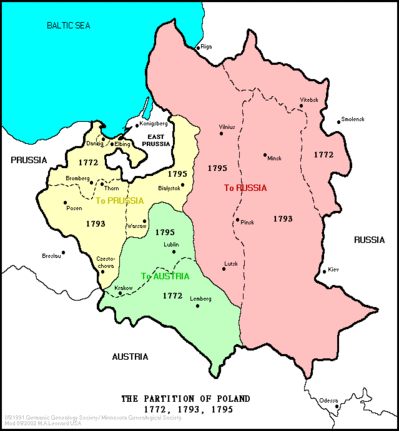
I won't dwell on the vast history of Poland (I'll let Wikipedia do that); suffice it to say its boundaries have changed over the years as neighbors fought over Polish land like they were in a taffy-pulling contest. Its ancient cities have been destroyed and rebuilt, or in some cases thankfully preserved; its people have gone from being Polish to being subsumed by one country or another, all trying to quash the Poles from existing...only to fail miserably as Poles would continue to rise up and be stronger than before. Check out this short two-minute video, time-lapse imagery of how the boundaries of Poland have changed from A.D. 990 - 2008, particularly the 10 seconds starting at 0:59:
Note that Poland was not even on the map from 1795 through 1918. The "Third Partition" split Poland into three regions, one each ruled by Austria, Prussia (Germany), and Russia. In fairly recent times, then, Poland did not exist for 123 years. Why? Poland lies in a very strategic location, being a sort of backyard fence of Europe to Russia's front yard, and by happenstance, has always been part of a tug of war between West and East. To add fuel to the fire, Poland's Vistula River valley is one of Europe's most productive agricultural regions, a rich, fertile area growing everything from apples to wheat. Anyone who rules Poland can feed their people for a very long time--or starve their enemies.
It took preparing for this bike trip to Poland in 2019, then, to hit me that my grandmother, the proud Pole that she was, wasn't even born in "Poland" in 1892. She was Austrian-born, technically. Poland had been part of Austria at that point for over 100 years! For 57 years, I had taken that I was Polish ("one set of my grandparents were born in Poland") without truly understanding that they really weren't. At least as far as maps and politics went.
But Polish culture is stronger than steel. It persevered over a century to remain intact: language, culture, and Polish pride never waned. Babi was proudly Polish. Think about it. Would our culture remain unchanged if we were conquered, for 123 years, generation after generation? Would our great-great-great grandchildren say they were born in the United States if it hadn't been the United States for 100 years? We'd like to think so but it sure gave me pause to think of the amount of time that had passed since Poland was Poland and my grandmother was born. She was Polish. I am Polish!
So I ventured to Poland with the excitement of someone going to see their roots, and Poland did not disappoint. From our guides, thrilled to show us their country, to hotel and restaurant managers, to shopkeepers, to guides at museums and historic sites, all were welcoming, charming, and fun. It was evident that significant investment has been made by Poland into their country to modernize, as well as preserve what they can of their past.
Our bike tour guides Bibi and Hania (Anna) were exceptional. Leading, guiding, teaching, interpreting, fixing, feeding...they were simply the best. Teaching us a bit of the Polish language while we were ferried from one place to another (an extremely complex and challenging language, even for Poles!) was a treat. Their love of country was infectious and their knowledge unsurpassed.
Hania or Anna (L), and Bibi, our remarkable guides.
Bibi showing the Polish alphabet: letters/groupings in red are not in the English alphabet. Missing: Q, V, and X.
Our bike ride started in Warsaw, and rode through towns and countryside, mostly following the path of the Vistula River. Houses were adorned with flowers; the rolling hills were full of fruit orchards.
Decked out in bike garb on speedy new bikes, GPS maps on phone.... while a babushka has no problem keeping up with us!
Hania and Bibi were dedicated to show us everything Poland. It's hard to pick out just a few highlights! Early in the trip, we visited a museum of sorts. It was a museum...but also the home of a Polish gentleman who both collected historic artifacts, mostly from 1900 onward, and also created his own sculptures from scrap materials, from alligators to WWII imagery. This was out of the way, on a little property in a little town. Hania had cultivated a personal relationship with this elderly man that allowed us the privilege and honor to have a peek at his passions. They cared for each other much like a grandfather and granddaughter. This was more than guiding a tour group.
World War II remains a strong influence on the creative spirit of Poles.
An eagle is the Polish emblem and on their flag, a symbol of strength and fortitude.
A chapel on the premises, with the owner and Hania
Model of a school room, with historic items collected over years.
In the historic town of Sandomierz, we toured the "Wailing Wall," a memorial to a Jewish cemetery and the people therein that was destroyed by Nazis. They removed and broke up headstones to use as pavers to create roads their tanks would drive over. A revered place now; people from over the world visit to pay homage to their ancestors.
Remembrance notes held firm by small rocks were left by visitors on top of replaced headstones.
Did you know that Poland has two of the first 12 UNESCO named World Heritage Sites? The city of Krakow being one, and the Wieliczka Salt Mine the other. To be fair, the U.S also had two: Mesa Verde and Yellowstone National Parks. While we've all probably heard of ours, I readily admit I've never heard of the Wieliczka Salt Mine. Poland never failed to amaze, and this salt mine was at the top of the list (More information found here).
Salt, as a food preservative, for centuries was more valuable than gold. Can't enjoy gold if you don't have food....
A rock salt deposit actively mined since the 12th century through the 20th (900 years, ceasing only in the late 1996 and becoming strictly a tourist destination), the overall length of the tunnels (over 178 miles) and depth of the excavations (over 350 yards below ground) would in itself be astounding. Miners lived there. Their horses lived there and were treated better than most people living above ground!
Example of the depths of some chambers.
Since salt also has healing properties, sickness and disease was virtually non-existent. What's most striking is that miners, over the centuries, would carve religious scenes, alters, statues, and other decorations out of remaining rock salt in excavated chambers throughout the mine, culminating in a Great Room with salt crystal chandeliers, a carving of the Last Supper among others, and a tribute to Pope John Paul II. It was awe-inspiring and we completely agreed with UNESCO on their decision.
Both religious scenes and ordinary life representations were carved by miners over the years in already-excavated chambers. This is all made from rock salt.
The great room in the mine. Everything is salt: floors, stairs, banisters, carvings...
...even the crystals in the chandeliers.
Those were some of the highlights, but there was so much more! Every day was full of new experiences, sights, and activities. Making apple dumplings as a group for our evening dessert. Lunching on food we selected from a farmer's market next to castle ruins. Being pulled onto a dance floor by dancers in traditional dress to kick up our heels. Best of all, I made a new friend in my roommate Kyle, she and I were the "singles" put together, and I couldn't have picked a better roomie. Fun-loving and equally enamored with Poland, we share many fond memories.
My roommate and new friend, Kyle.
Ruins of Janowiec Castle, built in the 16th century.
A stork nest along a fairly busy street in a country town:
An evening with cultural dancers. Polka was involved.
Bibi and Hania would set up a snack bar at various stopping points. Even though we're riding most days, do ya think we lost any weight?
An interesting boat on the Vistula River near Sandomierz
Bicycles with flowers grace a street cafe.
When one is out of pots (and bikes, I guess) but must have flowers.
The bike tour ended in Krakow. We spent an additional three days in this amazing city, exploring what we could cram in during this short period of time. Krakow, a significant headquarters of the Nazi regime, remained largely intact through WWII. Walking through the colorful, busy streets, it was hard to imagine Krakow was anything but a radiant and robust city. The shadow of the Nazi occupation was not hard to feel, however. The Poles will never forget their occupied status and rightfully so. It truly was a blend of past and present, but with a definite eye to the future.
The Vistula River in Krakow
Wawel Castle in Krakow, residence of Polish kings. One of the reasons Krakow was chosen to be among the first 12 UNESCO World Heritage sites.
The inside courtyard area of Wawel Castle held churches and chapels too numerous to count. Most European architectural styles are represented at Wawel Castle.
Walking through the city from Wawel Castle to the Main Market Square made my neck hurt. I was continually looking up to see building adornments, so carefully carved or welded centuries ago. Statues and churches were sprinkled among the centuries-old buildings, still lived in and loved. Some churches dated to the 11th century.
Now that we were on our own, a separate tour guide took Jeff, Jo, and I to the historic Jewish Ghetto (a district also known as Kazimierz, different than the town of Kazimierz), now becoming revitalized and a mecca for arts, crafts, and food. We walked from there to the Schindler Museum, created in Oscar Schindler's factory. This museum's focus is on the impact of the Nazis and WWII on the city of Krakow.
Kazimierz district, the historic Jewish Ghetto, is an up-and-coming neighborhood now.
Cobblestone streets in the Kazimierz district.
The 33 "Empty Chairs of Krakow," each chair commemorating 1,000 Jewish lives lost from being relegated by the Nazis into the Kazimierz district. This square was a community space until it was used by Nazis to select who from the ghetto would be transported to concentration camps, or sometimes executed on site. A phenomenal summary found here.
A cafe in the Kazimierz district. Very clever tables!
Displays throughout the district showing where the movie Schindler's List was filmed
Nazi rally at the Main Market Square, in front of 13th-century Cloth Hall, the indoor market building traditionally used for cloth/clothing trade and sale. Photo taken at Schindler Museum.
Cloth Hall today.
Krakow's Town Hall Tower on its main square, during a Nazi march. Photo taken at Schindler Museum.
Town Hall Tower today.
Another day, we caught the earliest bus to Auschwitz/Birkenou concentration camp, to be one of thousands who visit daily, continuing to bear witness to the most horrible atrocities humans let onto other humans. It was there, too, staring at a hard wooden bunk in a barrack that I came to have a deeper realization that such horror brings humans a surreal ability to plumb the depths of their souls to endure and persevere.
Fields of barracks burned by the Nazis when they found out liberation of their prisoners was imminent.
We then returned to Krakow's Main Market Square, browsing shops and stalls displaying amber jewelry, woodcarvings, famed ceramic pottery, and everything in between. We ended that day at the ancient St. Peter and Paul church listening to a pipe organ and string ensemble playing Bach's Toccata and Fugue in D Minor (which happens to be my brother's favorite classical piece, and certainly one of mine) among other brilliant compositions.
Most certainly, my time in Krakow magnified my understanding of how human beings walk a tightrope between conquering and creating. The Polish people are embracing their future with a contagious optimism that it will be a creative one. Of course they are, they're Polish! And so am I.