Thursday, April 9, 2015

Bilaga'ana among the Diné: Canyon of the Curly-Haired Chief


Overview of Canyon de Chelly; from map in visitor center
There's a big chunk of northeastern Arizona (pretty much that entire quadrant) that belongs to the Dine' (the People), or the Navajo. They share their high, windswept desert, multi-hued mesas and buttes, and vivid blue sky with the Hopi, and more recently, us Bilaga'ana, or white people (mostly as visitors). Both the Hopi and Navajo have lived in this area almost continually for centuries (barring the forced migration out, see below). With that sort of history and sense of place, imagine the stories they can tell.


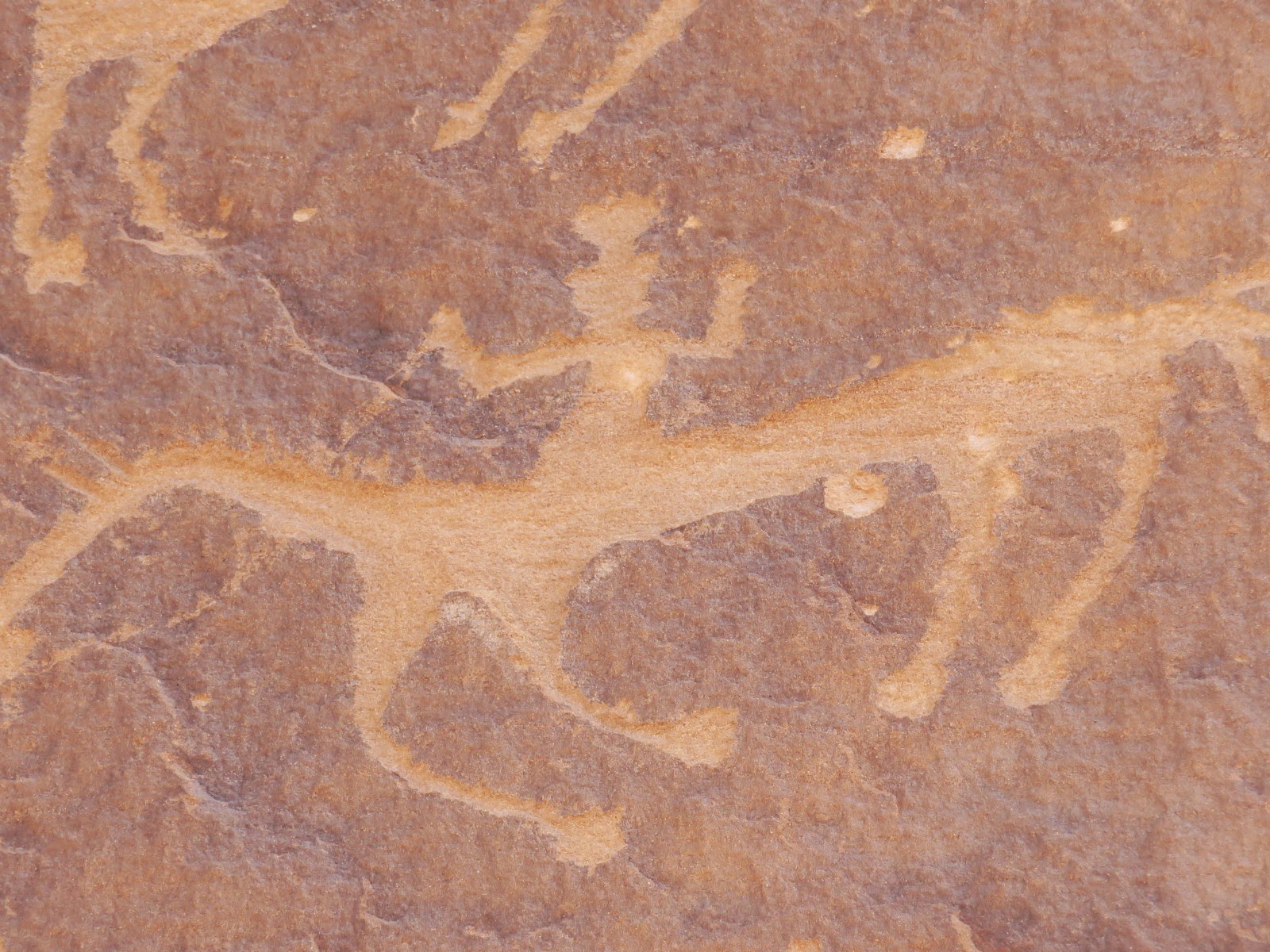
And they do. Stories and tales abound, many handed down verbally over time to family and clan. Some, however, are etched in rock as petroglyphs, others are painted on the vivid red and tan canyon walls with a mineral powder mix as pictographs--and these stories seem to be the most magical of all because in many cases, it's up to our imagination to determine their meaning.


Both cultures merge in Canyon de Chelly ("de shay"), just outside of Chinle. While fully on Navajo land and managed by the Navajo people (and National Park Service) as a national monument, Canyon de Chelly has both Hopi and Navajo history, as well as Anasazi, who inhabited this canyon long before these relative newcomers.



With friends Sharon and John, Bruce and I took a guided tour this past weekend. To travel along the bottom of the canyon, you must be accompanied by a certified guide. There are other options for visitors; one is to drive the two roads along the periphery of the canyon on the top; and a second option is to hike down to the famous White House Ruins (any calendar of the southwest will probably have a photo of White House Ruins) which gives some sense of the splendor that awaits when you're in the bottom of a red rock canyon looking up. We chose the guided tour, as that would offer more opportunities to see ruins, petroglyphs, and pictographs.


Our guide, Delbert George (he went by George), was eager to share his wealth of stories and information about the canyon. To become a guide, he had to undergo an interview process that tested his knowledge of the geology, cultural history, and current management of the park. He also had to answer such questions as "which family lives at the base of the big rock by the tree stump, and which family owns that peach orchard at the curve of the river by Two Owls rock?" The guy knows his stuff, for sure.

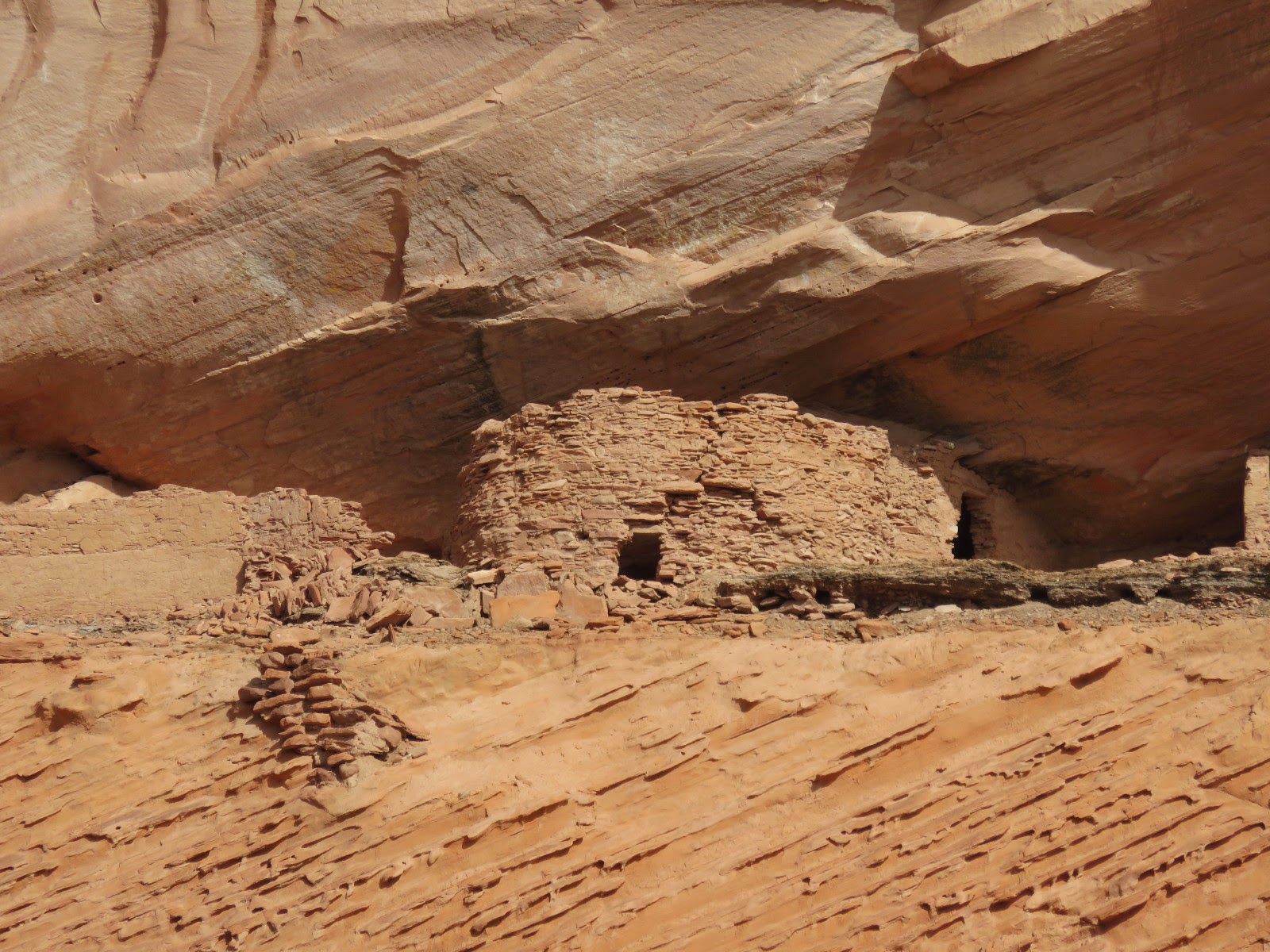
To make a centuries-long story short, the Anasazi, a prehistoric Pueblo people, lived--and flourished--throughout the Four Corners region in the American southwest from about A.D. 1 to 1300. Then, from reasons not totally understood even today, they essentially vanished across the land. Much of the rock art here, as in other areas, are from the Anasazi; but there is also early rock art from Navajo and Hopi peoples scattered throughout the canyon. Most, if not all, of the very cleverly-designed pueblo dwellings (adobe and wood) were constructed by the Anasazi, and found on ledges, nooks, and crannies that seem to be impossible to reach. You see later, as Delbert George would point out, small indentations signifying hand and footholds along the canyon walls to access these dwellings. How did they get the materials up there to begin with? How did they haul water and food up there while scrambling up a vertical wall using only fingers and toes? It's a marvel of human grit and the determination to be safe and survive.

Had it not been for both the rock art and the solid foundations of their structures, they would be unknown to us, as the next people to arrive and inhabit this canyon came 200 years after the Anasazi left. Archaeologists popped in and out, when allowed, to conduct formal inventories of the cultural resources in the canyon around the early 1900's, around 1965, and in the early 2000's. By the end of the 1965 survey, about 430 sites in total were documented. The latest survey in about 2004 found about 1,000 more sites. Even now, archaeologists estimate only 65% of the entire canyon has been surveyed. More treasures remain to be found.


Perhaps the most famous ruins in Canyon de Chelly:
White House Ruins, named for the almost-gone
white wash on the original walls
Those people to arrive 200 years after the Anasazi left were the Hopi, and then later on the Navajo. The Hopi are a part of the larger Pueblo native culture, while the Navajo are descendants from the early Athabaskan peoples migrating slowly from the Bering sea and dividing into the tribes of interior Alaska/northern Canada/Pacific northwest; and the Navajos and Apaches of the American southwest (the Navajo and Apache languages are surprisingly similar). Living rather peaceably with each other with a few skirmishes here and there, but eventually wanting the canyon to themselves, the Navajo finally ousted most of the Hopi over time. Adding their own brand of rock art, they recorded ceremonies, historical events, cultural markers, and tokens of daily life.


Canyon de Chelly is just one area in the homeland of the Dine', which stretches between four mountain peaks in the Four Corners area, all considered sacred: Blanca Peak (Sisnajini) and Hesperus Peak (DibeNistaa) in Colorado; Mount Taylor (Tsodzil) in New Mexico; and the San Francisco Peaks (Dook'oosliid) in Arizona. To subdue the Navajo (who used Canyon de Chelly as a stronghold) when the Bilaga'ana arrived, a certain Colonel James Carleton led a campaign to remove the Navajo entirely away from their homeland to force them to "forget" their heritage. He engaged Kit Carson to lead this effort in 1863--which they called the "scorched earth campaign." Thousands surrendered and were gathered at Fort Defiance, and then forced to walk nearly 400 miles to Fort Sumner in eastern New Mexico.

Map of Four Corners area showing Navajo place names

A little closer
After four years of imprisonment at Fort Sumner, even U.S. soldiers recognized the inhumane conditions under which the Navajo suffered, and began to contact Washington D.C. officials to end this incarceration. In 1868, the Navajo Treaty allowed the Dine' to return to their land. This entire experience is known as the Long Walk Home.

Even closer; see Chinle and east of that, "Tse' Yi'"
or "Chelly" as we dumbed it down
Canyon de Chelly was one of these areas the Navajo called home. The canyon became divided into eight large clan-based plots, each managed by a chief; seven of these areas were for Navajos; one remained under Hopi ownership. One Navajo chief was named for his curly hair, the Navajo pronunciation sounds like a guttural and mouth-clicking "tsst-ayi", which over time morphed into "Chelly." So the literal translation of this incredible place means Canyon of the Curly-Haired Chief. Canyon de Chelly became a national monument in 1931, encompassing 83,840 acres (about 130 square miles). It lies solely on tribal lands; the National Park Service essentially manages the walls of the canyon; their jurisdiction ends at the bottom of the canyon walls. As such, about 40 families with historic and documented ties to the land remain in the monument's three canyons, earning a living through farming and livestock grazing.

I was under the perception that the Navajos and Hopis aren't...well...the best of friends. This notion was dispelled by Delbert George, who said with a flourish "oh, that feud was so overblown," and proceeded to relate the story of two warring families a decade or two or three ago (the details escape me as I was already hypnotized by all the stories I was hearing), Navajo and Hopi, one whose daughter married the other one's son. They couldn't decide where to live--on Navajo land, or on Hopi. Court case followed, a lot of angst, bad feelings, people lining up on both sides, and absolutely no agreement; the judge decreed he would divorce the couple. Each had to return to their respective families, and the families had to stay away from each other permanently. Almost made the Hatfields and McCoys seem tame.

As we tour the canyon, we see families tending their crops and sheep grazing in pastures. Orchards of fruit trees pepper the creek flowing through the canyon. It is a well-lived and well-loved place.

Grazing in the shadow of pre-historic ruins,
how cool is THAT?


Riding up and down the canyon, visiting ruins and rock art sites, talking with craftsmen and women, listening to Delbert George relay story after story--it was a memorable day. However, I think it will be the moments of silence, when just the breeze and cottonwood trees talked to me as I pondered these ancient drawings and homes, that I felt the most connected to this place where red rock, blue sky, and green trees meet, and where the conversations of the ancient Anasazi may be heard if you listen closely enough.


Saturday, December 20, 2014

Monday, December 1, 2014

I Jump on a Box

When winter settles in for the long haul, well, yuck. Days are shorter, darkness comes early and stays well into the morning; the ground turns to mud or slushy snow--and I gain weight. I then spend spring, summer, and fall trying to lose those pounds I gained, only to face those pesky pounds yet again come the next winter. It's a vicious cycle that has had me bouncing around like a pinball for several years now, and I decided it was time to get off this pony ride.

To shake things up and turn my winters around, I joined our local gym, Bodyworks. Egads, the dreaded gym! Hauling a gym bag everywhere. Wet towels and gym clothes in the car which get forgotten on laundry day (dammit!!!). But, I figured a couple days a week using the elliptical and a few machine weights might help stave off winter pound-creep.

Deep down, though, I knew I needed something more intense. Weight machines and I go way back; while we're on friendly terms, neither one of us have pushed the envelope with each other. They don't badger me when I don't work them until my muscles fatigue, or when I rationalize blowing them off because the stars aren't aligned--or I have Other Very Important Things to do--or maybe because it's a Tuesday. It's just too easy to half-ass the weight machines.

While I was relatively content with my recent weight loss and in general my physical health, I had a bit of loose skin here, and some huffs and puffs biking up a hill with everyone breezing by me there. And I know, from common sense and research, that lifting Really Heavy Things is good. Strengthen muscles, become a better bike rider, build bone density (a good thing at this point in my life), maybe move some flab off my thighs, and simply be way more fit and healthy--there's no down side.


So if I'm going to do this gym thing, might as well do it right, right? Along comes Gabe, one of the gym's personal trainers. Three days a week, he gets to work with me, this 52-year old weight-lifting noob who is just learning the difference between a squat and a benchpress.

Our first session was an "assessment" geared towards finding the proper weights to start me off. Heavy enough to bring me to muscle fatigue but light enough that I can at least do a few repetitions (reps) per set. We went through a number of free-weight exercises, doing a rep or two testing various weights, and for the most part finding out that just the bar with no weights on it at all was about right for me. Rock on, power girl!

This assessment turned me into a wet noodle. My legs, chest, and arms were fatigued, and at the exact moment I thought I was done and could crawl into the locker room, Gabe said "let's go jump on a box."

Huh?


He brings me over to this plywood box. The height, depth, and width were all different dimensions, so you had a selection of heights with which to injure yourself. He stood with his toes about an inch from one of the sides and jumped up, both feet at once, using his quads to pull up his knees and feet, landing on top of the box. "Your turn," he said.


I froze. Nope nope nope. The shortest side of this box was higher than my knees. 


Panic set in, my mind raced, and in a nanosecond, I envisioned what would undoubtedly occur. Jump up maybe an inch or two; slam my toes into the side of the box; fall over frontward or backward or sideways and break something; end up in a hospital in traction; months of inability to move; 75 pounds gained. I may have been looking at a box, but I was seeing an enormous me down the road, angrily snarling at strangers "I'd be fine if it weren't for that damn box," and I was terrified.


He sensed my terror. Was it the deer in the headlights look? Or the sheen of sweat that immediately popped out on my face from a mix of panic, nausea, anxiety, and dread? Or the "No #!@&ing way!" coming out of my mouth? Whatever it was, he capitulated and got out a shorter box, this one being about a foot high--one of those black irrigation pipe covers with a green lid.

If the black box freaked me out, take a look
at Evil Box again, and imagine my first reaction
I stood in front of this box while he coached me. Jump up, lift your legs, you can do it. I don't really know what I heard, he wasn't getting through the fog of fear surrounding me. Countdown: "One...two...." nope. "One...two...thr..." nope.


That box gets put aside. He pulls out one of those steps used in aerobic classes. It's about three inches high. "Try this."

Ya think???
Determined but sloppy, I sort of hopped, one foot just a tad bit behind the other foot, onto that step. He added more height, I was looking at maybe five inches to jump. I can't remember, I think I jumped, but I was such a sorry piece of work it was laughable.

"We'll have to work on the box." Great, now I knew we'd be going through this horror show again. I was kind of hoping he'd see the writing on the wall and drop it.

A couple weeks go by; each session is a mix of upper/lower body, or push days, or pull days, or leg days...no day is exactly the same. On leg days, my mind wandered to Evil Box. I didn't say anything though, foolishly hoping that maybe he'd forget about Evil Box. Oh, Grasshopper, you will learn.


Of course he didn't forget. A week ago, after a bunch of legwork, I hear "Oh-kaaaay, time for the box!" (me, slowly walking like a prisoner to her execution, whispering while crossing myself "In the name of all that is holy, noooooooo, not the box.....)

He brings out the 12" black box, saying cheerily, "You can do this!"

Giving him the look of death, I fiddle around. It's not in a good place, I want it near a wall to break any forward fall. We moved it. I stand there, looking down at my feet. Maybe if I move it a few inches this way, it'll be better. No, over here is better yet. Gabe waits, patiently. I was reminded of the first time I dove off a high diving board. Regular one, no problem. High dive? Creep to the front, toes gripping the edge, bounce a little bit, look down, nope. Turn around, go back a few steps, and repeat.

That was me, here, with my box. Crouch down in preparation to jump. Mental countdown. Balls of feet and legs quiver in anticipation of their need to perform the perfect combination of jumping and pulling myself up through thin air. One...two....nope. Straighten up, defeated. Step back. Repeat. Gabe: "You're letting this get into your head. Jump." Uh, yeah. My head sees everything that can GO WRONG and that THIS BOX IS GOING TO KILL ME.


Oh my god, what a weenie am I.

Sometimes, you get so sick of yourself, you'd rather just jump and let the world crash down on you (at least I could say "I TOLD you so!!!") than bear another second of exasperating paralysis by fear.

I jumped.

I landed on the box.

I screamed (I think???), danced around a bit, and gleefully hugged poor Gabe (this woman must be nuts). Gabe told me "three more times, then rest, then eight more times." After that 8-rep set he said "two more." All with me landing on the box. Like this (boy, I wished we had a video of that first time, but this will have to do):


So, after a few weeks of training, we are actually adding weights to the bars. Pretty small weights, but weights nonetheless. My form is getting a little better every time. I deadlifted over 100 pounds for the first time a couple weeks ago (now I'm up to 115 lbs!), and I'm sure there will be other milestones achieved by next spring. Things like that make weightlifting pretty addictive for me.


I'm still freaked out about Evil Box, which Gabe says I'll be jumping on soon. But I don't think anything will pack the same wallop for me as jumping on that first box, because that was way more than just moving my body--it was about pushing the weight of fear out of my mind, and that is the biggest success by far.


Sunday, August 10, 2014

Amazonas: Singing its Superlatives

I have traveled a bit in my life, and have come to realize that there are, generally, three outcomes of experiencing a new place: 1) glad you went, got the t-shirt, may have been an interesting place, but there's no urge to visit again; 2) liked it, and don't necessarily need to go back unless someone else pays and then I'd be happy to; or 3) loved it, left a piece of my heart behind, would go back tomorrow, and you'd better be prepared if I decide to stay there for the rest of my life.

Yup. #3 here.
I never thought I'd feel #3 again after visiting Tanzania when I was 19 (a trip that gripped me like no other place I'd been before, or since) until my trip to the Amazon River. If I had to describe it prior to July of this year, my preconceived notion was "sweltering, buggy, humid...but with lots of cool birds and things to see that would make the miserable conditions worth it." After July of this year, I now say "a true tropical paradise, interspersed with brief, random moments of sheer terror." Which to me, is a more apt--and interesting--description.

Almost hitting a hive of killer bees while
out and about at night
This July, I went to the Amazon River to experience two weeks of its natural splendor. I have lots of pictures. I could write a dissertation chronicling every day and detail. But that would ultimately be pretty boring for you to read. I don't know of anyone who really wants to hear about every moment of someone else's adventure. So after some thought, I have decided to write this first introductory entry describing the general outline of our trip and a few Amazon superlatives to give readers an idea of the fascinating world in which I dipped my little toe. Over time, I'll write up a few stories of some specific experiences that stood out for me to remember--and, taken together, should give readers the "jizz" (birdwatching term describing the overall look and feel of a bird) of the trip.

I knew the Amazon River and its surrounding rainforest was big. And, well, biologically diverse. I guess it didn't hit me until I went there HOW big and HOW diverse.


For starters, let's look at the river itself. Most write-ups of rivers generally list them by length (The Ten Longest Rivers In The World!) or by volume of water carried (The Ten Largest Rivers In The World!). The Amazon is the second longest river, nudged out by a nose by the Nile River (4,180 miles for the Nile, 3,912 for the Amazon) [Never fear, America, the Mississippi-Missouri complex is third at 3,710 miles]. This is from one source; others claim different lengths for each of these rivers, but I'm not going to be picky here because the Amazon comes in at #2.

It's the volume of this magnificent river that makes it shine in the statistical books. The Amazon is #1 by a long shot. The Amazon holds about 1/5 (20%) of the world's river-based freshwater. It is larger, by volume, than the next 7 largest independent rivers combined (two more rivers in that top ten list are tributaries of the Amazon, the Madeira, #6 and the Rio Negro, #8, and those aren't included). The Nile doesn't even enter the picture in the top 30 of this list [the Mississippi-Missouri complex ranks 15th]. The Amazon carries, on average (so this is averaging the highest flows during the 6-month rainy/flood season with the lowest flows of the dry season) 209,000 cubic meters per second (or for us U.S. people, 7,380,765 cubic feet per second). At high flows, the volume has been estimated to be 11,000,000 cubic feet per second.

The Amazon River drains a 1.4-billion acre watershed; over half of this watershed is in Brazil in the region known as "Amazonas." The rest is shared with Peru, Venezuela, Ecuador, Colombia, Guyana, Bolivia, Suriname, and French Guiana. Two general drainage areas split the main tributaries of the Amazon--the Andes Mountains drains into the southern/western part of the watershed, ultimately landing in the river the Brazilians call the Rio Solimoes (So-lee-MOE-ez; but others refer to as the Amazon proper), and the Guyanan Highlands across northern South America drain into the Rio Negro and other northern/eastern tributaries. The Amazon and its tributaries enter Brazil with only one-fifth of the flow it finally discharges into the Atlantic, yet already at that point has a greater flow than the discharge of any other river in the world.

The Solimoes drainage carries quite a bit of sediment from the Andes Mountains. The water tends to have more nutrients--and is cloudier--due to this sediment load. The Rio Negro, draining the volcanic substrate of the Guyanan Highlands, doesn't have that sediment load. It does pick up tannic acid from the tannin-heavy rainforest vegetation, and is therefore clear but dark (think of a glass of clear iced tea), and--fortunately for us and the humans that live along it--too acidic for mosquitoes to breed. Unless you get into the interior of the rainforest beyond the edges of the Rio Negro and its acidic tributaries, you don't see or experience mosquitoes while on this river. An added bonus is that the Rio Negro water is like a vinegar rinse--good for your skin and hair.

"Blackwater"
Just east of Manaus, where the Solimoes and Negro meet to form the Amazon proper, is a phenomenon and tourist attraction known as the "Meeting of the Waters." The light-colored, sediment-laden Solimoes meets the clear, dark Negro. Their currents are different speeds, their relative density differs, and because of that, the two rivers essentially travel side by side, not mixing, for up to four miles. This separation is most notable, and easiest to reach by boat, just outside of Manaus.

Rio Negro, at left; Rio Solimoes, at right; we're now
on the Amazon River
The Amazon then picks up more and more water on its journey east to the Atlantic, emptying out its freshwater into the sea. The plume of freshwater is so great (and lighter than sea water) it can reach over 250 miles in length, and between 60 and 120 miles in width. Sailors over 100 miles into the Atlantic ocean can still scoop up freshwater off the side of their boat. Its mouth at the Atlantic, during high seasonal flood flows, can be over 120 miles wide (some documents cite 250 miles width; others say "wider than the distance between Paris and London"). At Manaus, where the Negro and Solimoes meet, it's already about 10-15 miles wide. Can I just add here that Manaus (some thousand-plus miles from the Atlantic) is only 144 feet above sea level--and that some of the Amazon River is actually below sea level, but its force and size push it upwards and onwards.

That's alot of water. And a huge watershed. Let's turn to the Amazon rainforest. If it was a country, it would rank 9th in size. Ten percent (some reports say up to one-third, or over 30%) of the world's known species live in the Amazon rainforest (over half the world's species can be found in all of Earth's rainforests combined). 20% of the world's birds live here, as do 2.5 million insect species, 40,000 plant species, and 3,000 fish species. There are so many plants that for the most part, native cultures would only bother to name those plants that are either beneficial/used or poisonous. The rest they didn't name; what a headache that would be, eh?

Some people refer to rainforests, especially the largest ones, as "the world's lungs," attributing the carbon absorption and oxygen-producing qualities of plants offsetting carbon build-up in our atmosphere. However, this is a misnomer; the decomposition of plant matter here absorbs about as much oxygen as the trees produce. It's more accurate to state that our planet's rainforests have a cooling effect on global climate, as they absorb a huge amount of heat from the sun. About 30% of our carbon emissions actually come from one thing--burning of the rainforests for agricultural uses/exploitation and human growth.

The Amazon and most of its tributaries are characterized by forests that become seasonally flooded during the 6-month rainy season. The river can rise up to (at times exceeding) 30 feet, flooding about 100,000 square miles of land every year. At the river's height, one can travel to normally inaccessible areas by canoe, effectively floating through the rainforest at mid-canopy height. Trees can be seen beneath the water, fully leafed out; birds and other animals can be observed more easily as you glide through the middle of the forest canopy in your canoe.

A flooded tree
This is why our trip was scheduled when it was. The height of flood season is just when the rainy season stops (end of June) and the river has yet to barely start receding. This is when you can best explore the forest--by canoe.

Floating through the mid-canopy layer of the rainforest
Our tour began and ended at Manaus. Upon landing at the Manaus airport (direct from Miami), we were shuttled to our boat, the Dorinha, that would be our home for the next two weeks. We would float a few days up the Solimoes, turn and come back to Manaus for a day visit, and then spend the majority of our time on the Rio Negro.

Hello, nice to meet everyone, what are we in for???

Our home for two weeks, the Dorinha

For the most part, our day would start at daybreak with a wake-up song played over the boat's P.A. system--Pavoratti's La Traviata to be exact; we'd grab a cuppa joe and enjoy opera, the wake-up songs of birds, and a bite of yesterday's dessert cake.


We'd then head into our three canoes as the day broke for a morning float into the forest.


A few hours later, we'd head back to the Dorinha for breakfast/brunch, and spend the heat of the day traveling further upriver on the boat with that time to ourselves for whatever we wanted to do: nap, watch the trees float by and see birds along the way, or in my case, pull out my crochet while sitting on the canopied upper deck and watch the forest and water glide by.


We'd then land somewhere fascinating and go for an afternoon canoe ride until sunset.


Back at the Dorinha, we'd have dinner and review "the checklist" (a gathering of the group to review every species observed that day).


Many evenings after dinner, we'd head back on out for a night-time spotlighting excursion. Let me say here that there's nothing like floating in the dark of night in the jungle, more stars overhead than you've ever witnessed before, with only a spotlight lighting your way as we looked for reflections of eyes that could belong to snakes, frogs, caimans, birds, tarantulas, or sloths. Shiver.


So come join me and hear my stories of Amazonas, which I'll be posting over the next several weeks. I hope you enjoy!


Wednesday, July 9, 2014

Cyrano: Pushing His Luck

Throughout June, we observed our House Wren Cyrano continue to woo his Roxanne. Every morning they would both be seen, singing from nearby branches and other favorite perches (our cobalt-blue gazing ball being one), happy to have found each other. Pretty soon, the stuffing of the old-man nestbox began; twigs, pine needles, and Carly's fur (the only benefit to the massive shedding of her winter coat) were schlepped inside until we thought not one more pine needle could fit. Then things quieted down as eggs were laid and tended. Oh, Cyrano still sang, but his song was noticeably quieter. We could still hear it--right at daybreak outside our open bedroom window, causing Bruce to have this love/hate relationship with him. The bird simply cannot stop singing.

Bruce's fancy new camera at work
We truly were thrilled, though, to watch this unlikely couple make a go at having a family. I was all set for this blog post to be centered on Cyrano, Roxanne, and (fingers crossed) new babies successfully fledging from the nest and entering the world. A nice little package of a story, wrapped up with a big happy bow. There is more to it, though--so just keep reading.

And indeed, the family was successful. At least three wrens hatched, and Roxanne and Cyrano hustled their little upright tails off bringing insects to nourish babies Edmond (for Edmond Rostand, playwright for Cyrano de Bergerac), Geraldine (for Geraldine McCaughrean, who re-wrote the play as a novel); and Martin (for Steve Martin, who wrote the screenplay for the movie Roxanne, winning a Writers Guild of America award). Note: Neither Bruce nor I are one for naming our yard critters, but what the heck. This is an exception.


Forage and feed, forage and feed, and on it went. Pretty soon, the heads of Edmond, Geraldine, and Martin started to appear as they grew. We could see the nest was packed with nest-stuff, and often when Cyrano or Roxanne would bring food in, they would take things out; cleaning house, so to speak. The usual item carted out being poop from the babies. Such is life, and you had to admire the cleanliness of these birds.


The light-colored rim of their beaks goes slightly downward,
making the young 'uns look grumpy. Quit complaining, I say!


The old man nestbox is starting to show a little wear and tear!

We didn't know exactly when the birds would fledge out of the nest. One evening while sitting on the back deck enjoying our yard birds and the sunset, we noticed that the box was quiet. Too quiet. Cyrano and Roxanne seemed to have disappeared. The eerie silence went on for about 20 minutes. Bruce and I looked at each other with pained expressions of heartbreak, sadness, and a tad bit of joy. The family may have moved on, but we played a tiny role in adding a few more wrens to this world. We couldn't believe how sad we were, though, and realized at that very moment how important Cyrano and Roxanne had become in our daily lives. It was just too quiet without them, and worst of all, we didn't get a chance to say good-bye!!!

Then....movement, wren-song, and what sounded like apologetic wren-chatter as Cyrano and Roxanne returned to the box and the family woke up with open mouths. Whew. All accounted for, safe and sound. Continue on.

It had to happen, though. Two days after the above photos were taken, the young birds popped out of the nest while we were on our morning walk, and old man nestbox fell quiet.

Two summers ago when our nesting juncos fledged (see earlier post), mom, dad, and kids left the yard right away, never to return. We hoped this wouldn't be the case with Cyrano and his brood. And it wasn't, at least not right away.


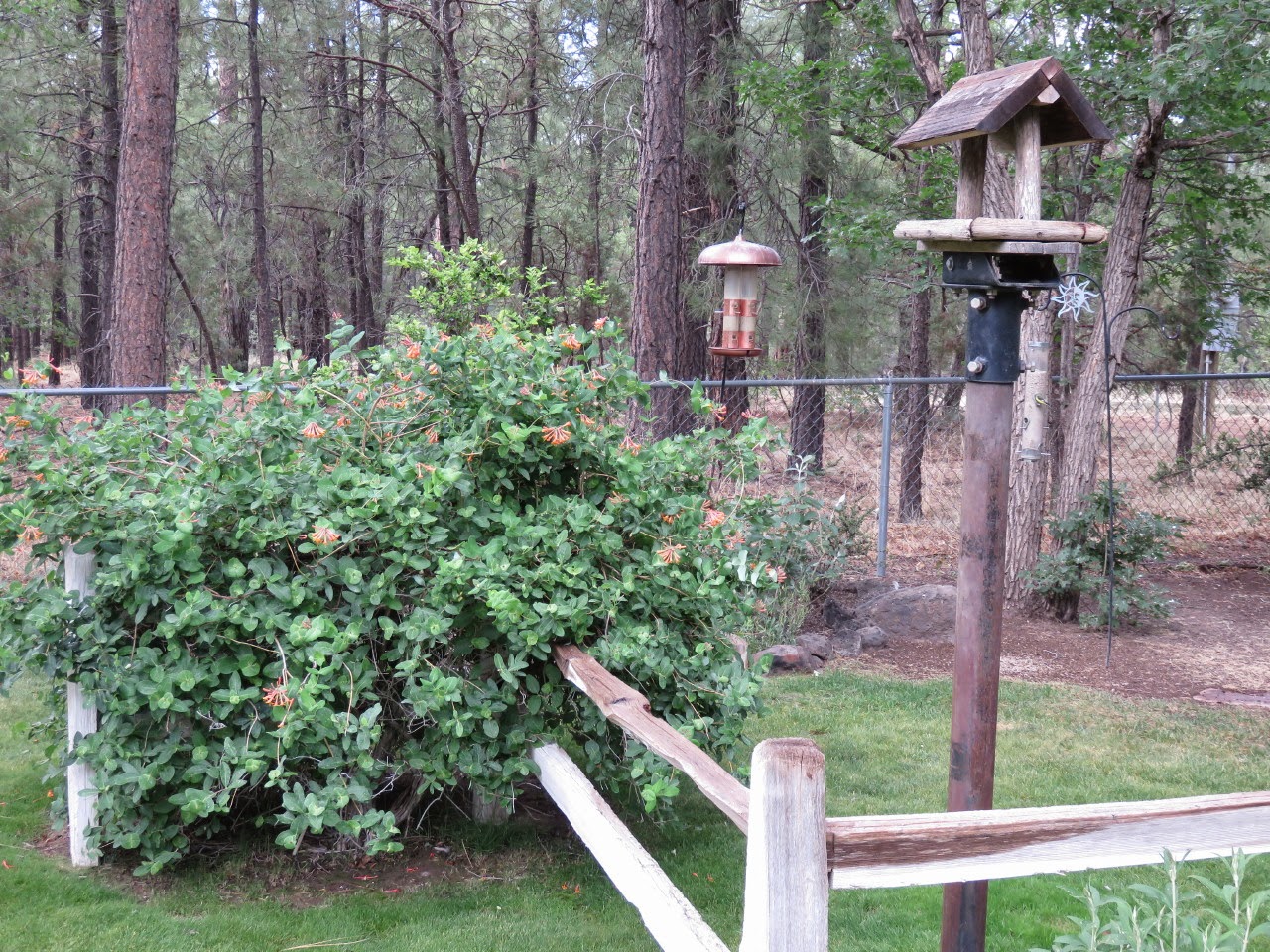
This section of our yard, especially the honeysuckle bush on the pole fence, became Wren Central. The young wrens used this bush as their fort, hidden away as they learned the ropes from mom and dad. Sections of the bush would sometimes tremble while the young bounced around within. Chattering noises abounded, making us wonder what sort of conversations were going on. And, we soon started seeing young wrens perched here and there, sort of huddled in a "please don't see me, Mr. Hawk" position.


For the most part, that's how it went. We think Edmond, Geraldine, and Martin, with Roxanne nearby, are exploring the great new world that is our yard and the adjacent forest of our neigbors, as we can sometimes hear wrens within earshot.

BUT wait, he's baaaaacckkk....Cyrano is at it again. Every morning, right as the dawn breaks (which is early; the clock's first digit is always a "4"), there goes Cyrano. Singing. Loudly. Constantly. Bruce gets up, harumphs and shakes his fist (albeit gently), shuts the window, and tries to get back to sleep. Which doesn't work, because now Carly is up and starts licking, nibbling, and growling to be let out.

The song of the wren fills our mornings yet again. There's Cyrano, bouncing all over the place singing loudly from every perch possible, advertising a second time what a great layout he found for just the right female. Did Roxanne tell him she's just not that into him? Will he succeed against even greater odds in finding a new mate, this late in the nesting season? Dude, don't push it; chill and go out on top!!!

I don't know what happened to Roxanne. She's probably hovering around her brood as they make their way into the forest. Cyrano, though, has transformed into a Don Juan. Now I have to research THAT guy!

Taken just this morning. Here he goes again.